
Escape Room for Kids at Home
Printable escape rooms for every age — codes, clues and a ticking clock, ready to print tonight.
- An escape room for kids at home is a printable PDF: a story, a chain of puzzles and codes, and an answer key. No booking, no travel, and it costs less than one ticket at a venue.
- Pick by age: 6–12 → a detective mystery; 9–15 → a spy mission; 12+ and grown-ups → a full escape room; 15+ → a murder mystery party.
- Plan 60–120 minutes of play and about 30 minutes to print, cut and set up. You don’t need real padlocks — sealed envelopes work just as well.
- For a birthday party, split into teams of 3–5, give each team its own copy, and keep a hint card handy so nobody gets stuck.
What Is an Escape Room for Kids at Home?
A printable escape room for kids turns your kitchen table or living room into the venue. You buy a PDF, print it on ordinary A4, and the children work through a story by solving a chain of puzzles — codes, ciphers, logic grids, hidden clues — where each answer unlocks the next step. At the end they crack the final code and ‘escape’ (or catch the culprit, or recover the stolen crown).
The difference to a treasure hunt? A treasure hunt sends children moving from hiding spot to hiding spot. An escape room keeps them thinking together around one table or one room, with a ticking clock. Plenty of our kits blend the two: detective cases with stations to search, and spy missions with codes to crack between them.
Printable Escape Rooms by Age
Every kit below is an instant PDF you can print tonight. Ages, players and timings come straight from each kit — pick the one that matches your youngest player.
| Age | Best kit | Players | What they solve |
|---|---|---|---|
| 6–12 | Detective Treasure Hunt | 4–12 | A stolen emerald crown: riddles, clues and evidence over 8 stations, two difficulty levels |
| 6–12 | Circus Detectives | 2–8 | Who sabotaged the circus? Footprints, fingerprints and coded messages; nine suspects |
| 9–15 | Spy Mission | 4–12 | Operation Black Signal: encrypted messages, logic puzzles and an evidence log; two levels |
| 12+ and adults | Wizard Prison Escape Room | 2+ | Break out of a wizard prison: 10 puzzle stations, nine runes, four-digit codes |
| 15+ and adults | Murder Mystery Party Kit | 2–10 | A locked-room case: nine suspects, evidence cards, code-breaking |
 Detective Treasure HuntCrack the case of the stolen Emerald Crown — suspects, fingerprints and codes. Ages 6–12.View the hunt · £12.99 →
 Spy Treasure HuntA top-secret spy mission with codes, gadgets and an Agent X to unmask. Ages 9–15.View the hunt · £15.49 →
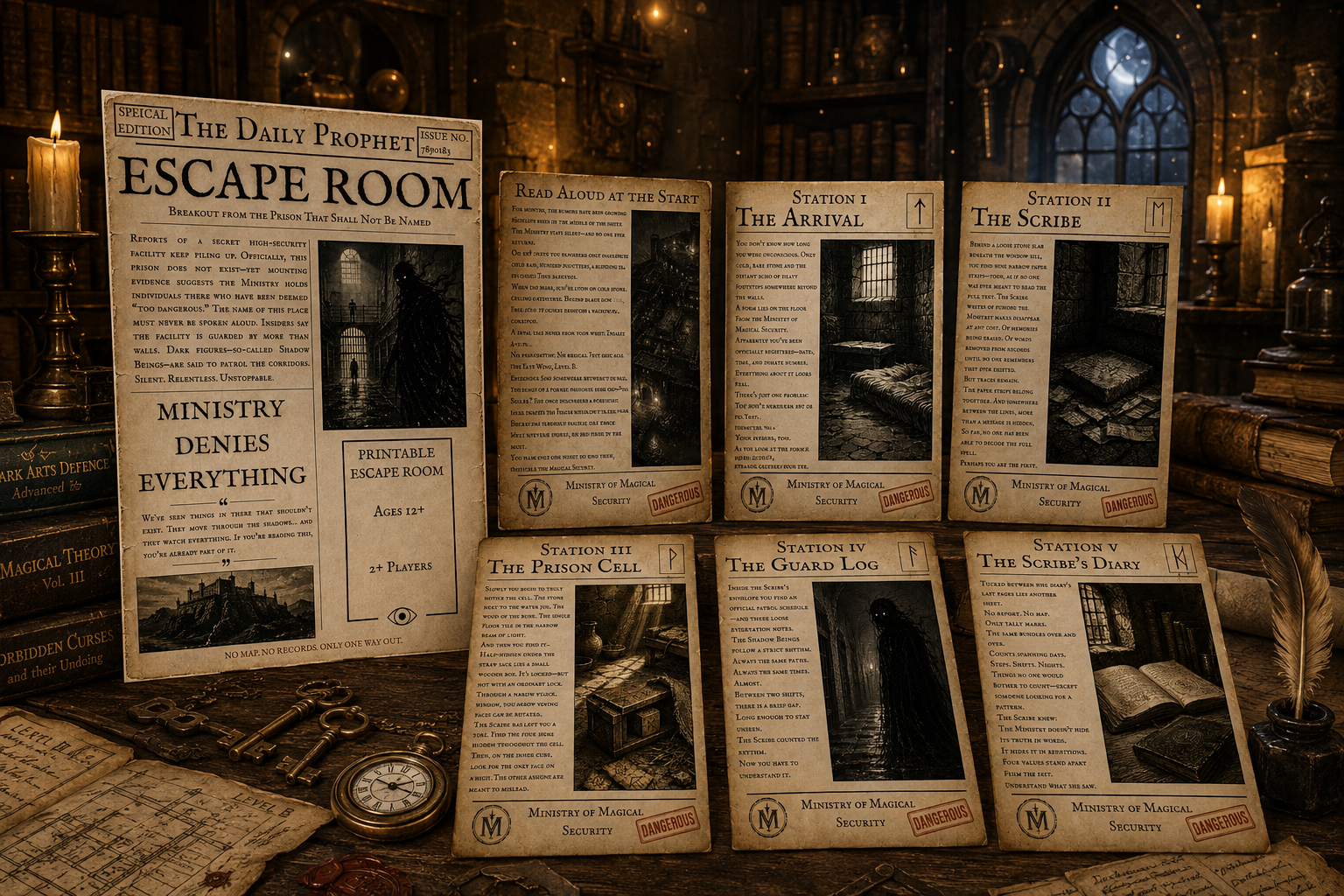 Escape Room: Breakout from the Prison That Must Not Be NamedTen puzzle stations and a forbidden escape charm. For teens and adults, 12+.View the hunt · £25.99 →
How a Printable Escape Room Works
- Choose and buy. Pick the kit for your youngest player’s age. Checkout takes a minute and there’s no account needed.
- Print and prepare. The PDF arrives straight away. Print on ordinary A4 (colour is nicer, black and white works), cut out the cards and put each puzzle in its envelope or hiding spot. Allow about 30 minutes — the wizard escape room takes 30–45 minutes of cutting, so do that the day before.
- Read the story and start the clock. Read the opening aloud, set a timer and let them loose. You’re the game master: hold the answer key and the hint cards.
- Celebrate. Every kit ends with a reveal — the culprit unmasked, the crown recovered, the spell spoken — and most include certificates.
Planning an Escape Room Birthday Party
An escape room birthday party works brilliantly at home, especially for 8 to 12 year olds who think party games are babyish. A few things make the difference:
- Teams of 3–5. Bigger teams leave someone twiddling their thumbs. With 10 children, run two teams with two printed copies and race them.
- A clear time limit. 60 minutes is the classic. Add a few minutes if they’re close — nobody remembers the timer, everybody remembers escaping.
- Hints on request. Give each team three hint cards. Asking costs them a minute, which keeps them trying first.
- A finale worth the effort. A locked tin or a sealed envelope with the party bags inside is the perfect last ‘door’.
For a step-by-step party plan, see our guide to hosting an escape room party at home. Spy-mad children will love our spy party ideas too.
Want to Make Your Own Escape Room?
You can absolutely build one yourself. Choose a story with a clear goal, write five to eight puzzles that get harder as they go, and make sure every answer points to the next puzzle. Our guide to secret codes for treasure hunts has ready-made ciphers (Caesar shift, pigpen, number codes) you can drop straight in. Test the chain yourself first — the most common DIY problem is one puzzle with two possible answers.
Honestly, a homemade one takes an evening or two to write and test. A printable kit gives you the story, the puzzles, the props and the answer key ready to go — which is why most parents I know buy one for the party and make their own for a rainy weekend.
Do You Need Real Locks and Props?
No. Every one of our kits works on paper. A sealed envelope marked “open with the code 4–7–2–9” does the same job as a padlock — the children still have to earn the number. If you fancy a bit of drama, a cheap combination padlock on a toolbox or biscuit tin is a lovely finale, and a torch makes any search feel covert.
- Pitching it too hard: Frustrated children give up. Fix: choose by the youngest player’s age and keep hints ready.
- Teams too big: Two do the work, four watch. Fix: 3–5 per team, print an extra copy.
- Not reading the story: Without it, it’s just a worksheet. Fix: read the opening aloud with a bit of drama.
- Setting up on the day: Cutting takes longer than you think. Fix: prepare the envelopes the night before.
Frequently asked questions
What age is an escape room for kids suitable for?
How long does a printable escape room take?
Do I need padlocks or special equipment?
Can I run an escape room for a birthday party?
What is the difference between an escape room and a treasure hunt?
Can I print it more than once?
Looking for more? Browse all our printable treasure hunts, or plan a grown-up evening with our murder mystery night guide.
Written and play-tested by Hannah — a Yorkshire mum of two and former primary-school teaching assistant. Last reviewed October 2026.