

- A scavenger hunt is a list of things to find; a treasure hunt is a chain of clues leading to a prize. Scavenger hunts need almost no prep, which makes them perfect for a rainy afternoon or a walk.
- Use picture lists for ages 3–5, word lists and photo hunts for 6–8, and riddles, timed challenges and teams for 9–12.
- Keep it to 10–16 items and 15–20 minutes for younger children. Agree boundaries before anyone sets off.
- Grab our free printable lists below — indoor, garden, autumn walk and a rainy-day colour hunt.
Short on time? If you’d like the clues and the story done for you, our Indoor & Outdoor hunt has 50 rhyming clue cards ready to print.
Scavenger Hunt or Treasure Hunt — What’s the Difference?
People use the words interchangeably, but they’re different games. In a scavenger hunt, children get a list — “a feather, something red, a conker” — and race to find (or spot, or photograph) everything on it. In a treasure hunt, each clue leads to the next hiding place until they reach the treasure. Scavenger hunts are quicker to set up and brilliant for walks and rainy days; treasure hunts take a bit more prep but feel like a proper adventure.
This guide is all about scavenger hunts. If you fancy the clue-chain version, our treasure hunt clues for kids and planning guide have you covered.
25 Scavenger Hunt Ideas for Kids
Indoor scavenger hunts
- Classic household list: a spoon, a sock, something soft, something round — the printable below is ready to go.
- Colour hunt: one thing in every colour of the rainbow. Lovely for 3 to 5 year olds.
- Alphabet hunt: something beginning with every letter from A to Z (allow a ‘joker’ for Q, X and Z).
- Shape hunt: a circle, a square, a triangle, a star — great for early maths.
- Texture hunt: something bumpy, smooth, fluffy, crinkly, cold.
- Book hunt: a book with an animal on the cover, a book with a number in the title, the smallest book in the house.
- Photo hunt: hand older children a phone or tablet and a list of things to photograph — no running off with the ornaments.
- Hide-the-toys hunt: hide ten small toys around one room and give them a list of what’s missing.
Garden and outdoor scavenger hunts
- Garden list: a feather, a smooth stone, a worm, a spider’s web, moss (printable below).
- Nature collection: fill an egg box with six different natural things — one per section.
- Bug hunt: a ladybird, a woodlouse, a snail, something with more than six legs. Look, don’t keep.
- Sound hunt: stand still and tick off a bird, a plane, a dog, the wind, a car.
- Smell hunt: sniff out mint, a flower, cut grass, a herb, wet soil.
- Shadow hunt: on a sunny day, find something whose shadow is longer than itself.
- Nature scavenger hunt with a twist: see our full nature scavenger hunt for kids.
Out-and-about scavenger hunts
- Walk to school hunt: a red door, a cat in a window, a number 7, a postbox.
- Park hunt: a conker, a squirrel, a bench with a plaque, a puddle to jump in.
- Car journey hunt: a tractor, a bridge, a horse, a sign with a castle on it.
- Supermarket hunt: something from another country, a fruit you’ve never tried, something that costs exactly £1.
- Seaside hunt: a shell, seaweed, a crab, a smooth pebble, a boat.
Themed and seasonal scavenger hunts
- Autumn walk: conkers, acorns, red, yellow and crunchy brown leaves (printable below).
- Christmas scavenger hunt: tinsel, a bauble, a robin — see our Christmas scavenger hunt for kids.
- Easter egg hunt with clues: chocolate eggs at the end of a riddle trail — our Easter egg hunt clues are ready to print.
- Halloween hunt: pumpkins, bats, spiders and a spooky story — ideas in our Halloween treasure hunt guide.
- Birthday party hunt: each item on the list is a letter; together they spell the birthday child’s name.
Free Printable Scavenger Hunt Lists
Four tick lists, ready to print on A4: an indoor scavenger hunt, a garden scavenger hunt, an autumn walk and a rainy-day colour hunt, plus a short how-to. No email needed — just download and print.
Download the free scavenger hunt lists (PDF)
Scavenger Hunt Ideas by Age
| Age | What works | How long | Items |
|---|---|---|---|
| 3–5 | Picture lists, colour and shape hunts, one room or the garden, a grown-up alongside | 10–15 min | 6–10 |
| 6–8 | Word lists, alphabet and texture hunts, photo hunts, small teams | 15–25 min | 10–16 |
| 9–12 | Riddle clues instead of plain words, timed challenges, team scoring, out-and-about hunts | 30–45 min | 15–20 |
| Teens | Photo and video challenges, creative tasks (“a team photo that looks like an album cover”) | 45–60 min | 15–25 |
Planning by age? Our treasure hunt ideas by age guide goes into detail for every age from 3 to 12.
How to Set Up a Scavenger Hunt (in 10 Minutes)
- Pick the place and the boundary. One room, the whole house, the garden, or “between the bench and the big tree”.
- Write or print the list. 10–16 items for younger children. Mix easy wins with a couple of tricky ones.
- Decide the rules. Collect it, touch it, or just spot it? For nature hunts, spotting is kinder to the wildlife.
- Set a timer. 15–20 minutes is plenty for under-8s. A whistle or a song on the speaker marks the end.
- Check the finds together. Celebrate the odd ones — “the best smelling thing” always causes a debate.
Scavenger Hunt Clues and Riddles
Want to make it harder for older children? Swap the plain words for little riddles. “I have hands but I can’t clap” is a clock; “I go up and down but never move” is the stairs. Our guide to indoor scavenger hunt clues has ready-made clues for every room in the house, and the treasure hunt riddles for kids post has dozens more.
Need a reward at the end? Our treasure hunt prize ideas keep it cheap and cheerful.
Seasonal Scavenger Hunts Through the Year
- Spring: blossom, a bee, frogspawn, the first daffodils — and an egg hunt with clues at Easter.
- Summer: beach and picnic hunts, a minibeast hunt, a long-evening garden hunt.
- Autumn: conkers, acorns and crunchy leaves on a woodland walk; a not-too-spooky Halloween hunt.
- Winter: frost patterns, a robin, a Christmas scavenger hunt round the house on Christmas Eve.
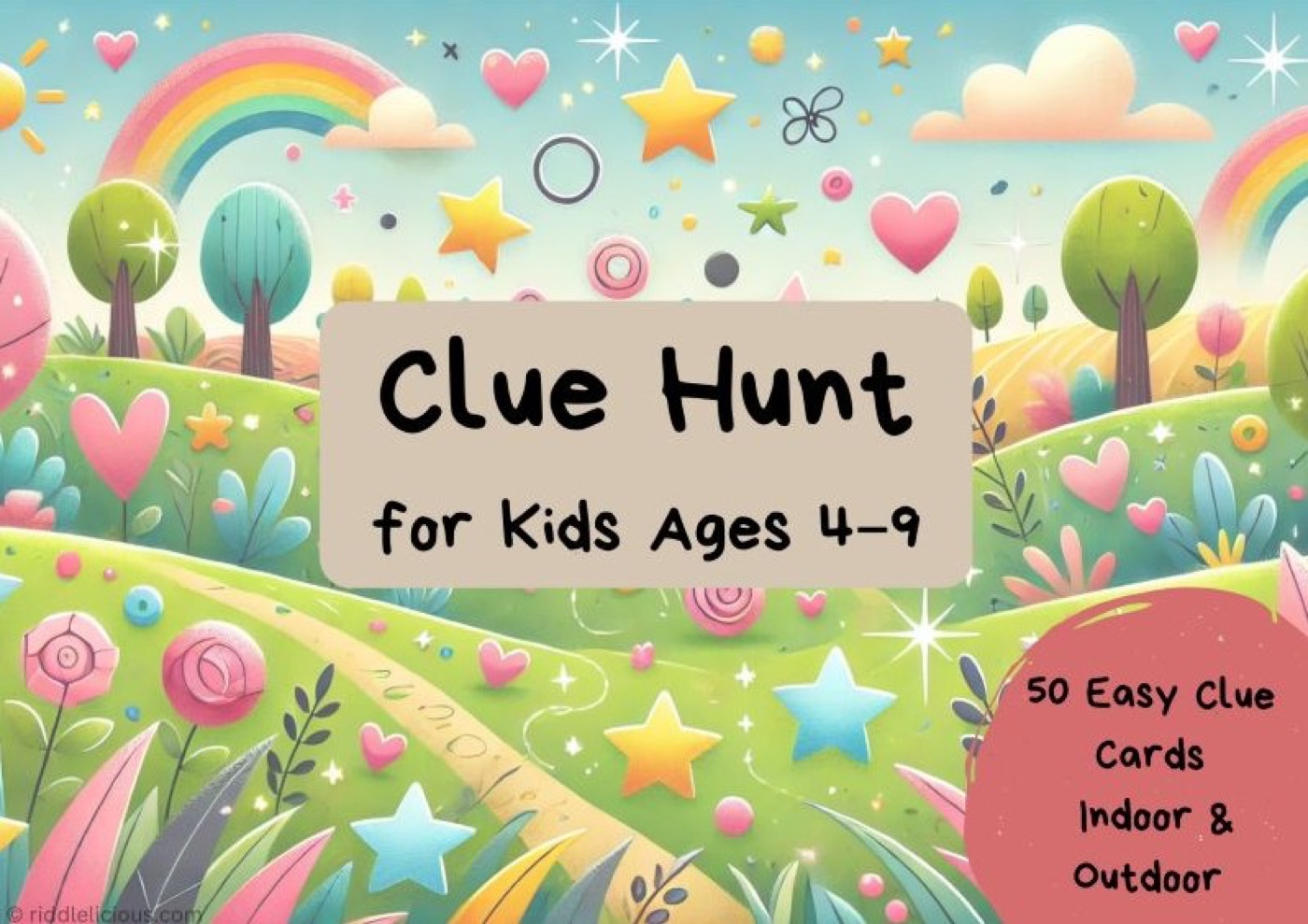 Indoor & Outdoor Treasure Hunt50 rhyming clue cards for the house, the garden or both. Ages 4–9.View the hunt · £4.29 →Forest Treasure HuntHelp Felix the fox save the woodland’s food before winter — 8 nature stations. Ages 4–12.View the hunt · £12.99 →
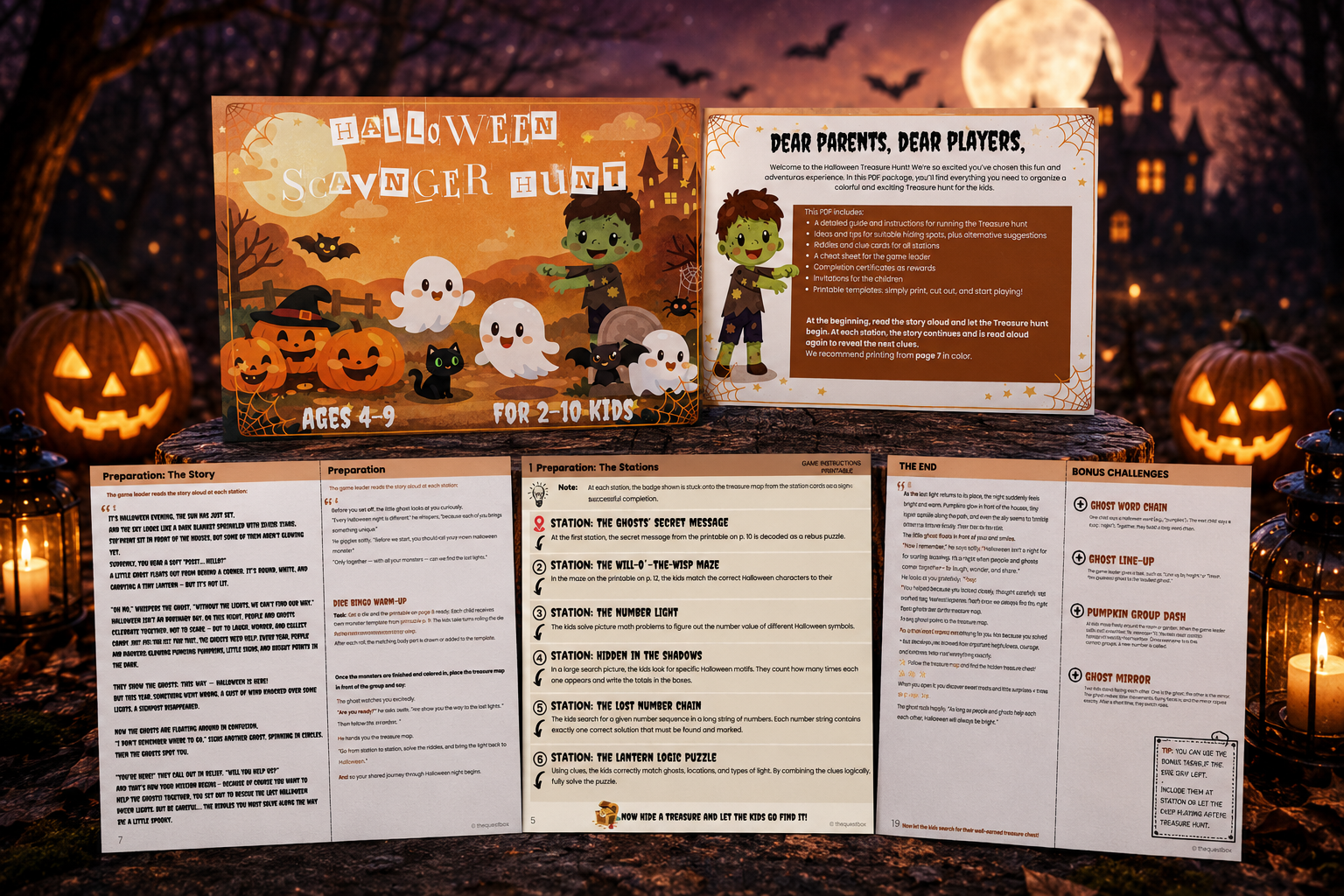 Halloween Treasure HuntRelight the ghosts’ lanterns — spooky-ish, never scary. 8 stations, ages 4–9.View the hunt · £12.99 →
- A list that’s too long: Twenty-five items and a five-year-old gives up at nine. Fix: 6–10 items for under-6s.
- No boundary: Someone always ends up in the neighbour’s hedge. Fix: agree exactly where the hunt stops.
- Collecting living things: Snails don’t enjoy a trip in a bucket. Fix: spot and tick, don’t pick.
- One winner, lots of losers: Fix: everyone who tries gets a sticker; the full sheet earns a small prize.
Frequently asked questions
What is a scavenger hunt for kids?
What should I put on a scavenger hunt list?
How long should a scavenger hunt last?
What is the difference between a scavenger hunt and a treasure hunt?
How do you make a scavenger hunt harder for older kids?
Are your scavenger hunt lists free?
More ideas: indoor scavenger hunt clues · Christmas scavenger hunt · Easter egg hunt clues · nature scavenger hunt · children’s party games.
Written and play-tested by Hannah — a Yorkshire mum of two and former primary-school teaching assistant. Last reviewed October 2026.
Hannah is the mum behind Riddlelicious — a former primary-school teaching assistant who tests every printable hunt on her own two before it reaches the shop.